Tuesday, July 8, 2014

Poets Wha Hae

Rabbie Burns looking dandy and Scots
Poets don't stand much of a chance in the 21st century. The art of poetry has been supplanted by other mediums, and poetry itself is relegated to either ancient history or teens scrawling in margins. Sadly... because poetry is a living art, and should stay alive. Poetry is the spirit of language, and language is a fundamentally human endeavor.  In fact, I would argue that poetry is the logic of the heart. 

Let me explain!

In the days of my friend Robert Burns, poetry was living language. He communicated politics, love, national sentiment, revolutionary fervor, and much more in poems. Poetry was alive in a way that seems quaint to us but was very much a continuation of what words had been for millenia. From ancient sagas to pamphlets, poetry moved through human existence, informing and enlightening. Somewhere along the line, sometime during the 20th century, poetry ossified. The logic of the Word, the power of Logos itself, ceased. We needed to rely on a colder, more precise logic to communicate. We became newspaper men and trivia experts, and moved away from the truth of the poem. 

Logic as a formal discipline is important, don't get me wrong. Understanding mathematical logic is a great task, and I enjoy a good discourse on deductive, abductive and inductive logics as much as the next person. But poetry is a logic of words. 

We exist as creatures of narrative reality. Our stories, our words, inform the world as much as anything else we consider objective and infallible. Ideas like integrity, honor and chivalry are communicated through poetic logics, the Logos. The ability, through words and speech, to make what was unclear clear. We are stories, as much as we are anything. Humanity exists in that realm, and tells stories to frame what we are for the present and the future people. If we lose poetry as an art, or diminish it to some academic and linguistic ghetto, we diminish ourselves. 

Burns died at 37, like so many fascinating figures of history have. At 37 now myself, I think of what I can communicate and leave to my children, my students, my peers. Certainly not a Burnsian body of work, or a linguistic and cultural revival on his level. But a few words. A step in the direction of humanity, of real logos as a meaningful discourse in the world. A verse of the narrative that moves and defines us, humble though it is. 

Tuesday, June 24, 2014

Crisp June Evenings and a Slight Wavering Towards Home.

Miller at Big Sur
Henry Miller spoke of the word home with venomous hatred. He saw home as an oppressive, stifling concept. While I don't necessarily share his passion, I do tend to agree with the sentiment. Home in an American context is a dull, harsh and sterile place. While Japanese people have tiny sweltering apartments filled with laughter and joy; and the Italians live in run down buildings with two simple pieces of furniture and smile through a shared meal. We sit and brood and compare in giant cavernous mansions filled with every convenience and luxury. Or we pine in noisy, cramped apartments for that same luxury we see in manufactured images of home. We find it unbearable or untenable to share any space at all, and we yell and scream and drive off others. Americans are the chattering birds of public squares.

I'm not excluding myself here, by any means. I'm as incapable of living with people as any other American. My spaces are as filled with gee-gaws and wasteful practices as any suburban American. And I'm certainly not making a moral judgment. Unlike Miller, who was disdainful of the American, I'm more baffled. I've lived in other places. I see how societies can work. I see the appeal of what my wife calls "intact societies." Not in a utopian sense- these societies are flawed as well, from top to bottom- but in a functional sense of being cohesive, relevant to human issues... well, intact.

All that is in my mind as I return to my new home. My place that is suited to me, ridiculousness and all. I'm settled, for as long as my children live here, in Ithaca, New York. The New York that isn't New York. It's a fine place- I may lament in my romantic weakness for a Prague in which to cross bridges... I pine in a bizarre academic sense for structured Berlin... I even long to round a spiritual corner in a Kyoto park. But Ithaca is a fine place. We have a lovely little house, the kids are thriving and growing. My own wanderlust is tied securely to nonsense I need to purge, and Ithaca is the place to do it.

And best of all, perhaps, Ithaca is filled with people who would understand completely what Miller means by home as an oppressive concept. Without malice or anger, they could listen and hear. They could, as Miller himself would say, talk without just heaving facts at one another. I can get into that. I will get into that. If a small part of me pines or laments from time to time, hey... I'm only American. Only human.


Saturday, May 17, 2014

Some Certain Amount of Ado about Something


Much Ado About Nothing is far from the greatest of Shakespeare's works. I don't often see it referenced in scholarly works about the Bard. It's certainly not his best writing, though it does have some interesting commentary on the human condition that still resonates with me.

It's a bizarre, farcical comedy about marriage and friendship. Shakespeare himself probably had a pretty low opinion of marriage as in institution- he certainly wasn't terribly fond of his own- but Much Ado looks at it in a bizarre but favorable light. He manages a few jabs. (Forcing someone to marry the cousin of the girl you've murdered with slander? Do they make a card for that? What's an appropriate gift to give?)

Mostly it's a cute and odd little play about honesty, trust, and how illogical and stupid love can be. I still think one of the things that draws me to Jaime is her Beatrice like disdain for the common trappings of relationships. Not that I can spar with her on the level of Benedict. It's more like Beatrice and Claudio. But I do try.

I think what makes me love this play beyond all reason is that love itself is a ridiculous concept. Romance is strange and wonderful, and the play captures this perfectly. One of my favorite scenes is when they are trying to figure out what to do with Beatrice, and she goes on about how she needs someone more than a youth, yet not more than a youth... She admits the ridiculousness of the entire endeavor. It's such a nice scene, because she's fully aware that she sounds absurd, but doesn't care. The entire situation is absurd!

Ultimately what makes it work out for everyone is admitting we're lost and confused. We admit it's insane and we just have to try our best to be there for one another. It's marvelously human, like Shakespeare could be at his best.

I do still wonder if Hero doesn't bring it up from time to time when Claudio annoys her.

"Oh you don't seem to be enjoying your dinner. Remember when you were such an ass to me that I almost died?!"

"No honey that's okay I don't need a new dress. Oh hey remember when you turned my wedding into a slut shaming party? And you got my dad to tell everyone he wished I were dead?"

Thursday, March 27, 2014

The Blogpost of Albion Moonlight


There are so many writers and painters and musicians and artists of every stripe that have profoundly and irrevocably affected me. It would be impossible to even imagine a me that isn't shaped by art. I suppose I can see hints in my family past of what I could be without the billions of words... but they're subtle and fleeting glimpses. Not really me at all. I've been tied to words and paintings since I was conscious, and that's just a fact of my being. I like to imagine that it's been thoughtfully and reasonably, and it isn't just indulgence in cliche. Flaubert lamented that mass media would replace thought, and we would become parrots of ideas regardless of content. I hope I've avoided the worst of that, but I guess I can't exactly know. I'm a prisoner of my "received ideas," as he would possibly put it. And even in quoting him perhaps I fulfill that dangerous prophecy.

Nonetheless. The art and artists are a part of me, and I accept it even while acknowledging I'm largely powerless to change it. Especially as I near 40.

And no artist has affected me as profoundly as Kenneth Patchen.

That is not to say he's the greatest, or the most important. He's not. He's not even, like Robert Duncan or Ronald Johnson, one of the poets who altered my perception of how poetry is understood. But he's the poet who most resonated with my own idea of a life lived in art. He, like me, was inexorably linked to his one lifelong love. He was largely unrecognized during his life, but continued to create and communicate in his work. Unlike me he lived in pain and relative isolation. But even that has served as a lesson for me. I resisted the temptation, strong at times, towards misanthropy that many artists succumb to. I also had children, which provide a perspective and a joy that helps a person to find some solace in human company.

After all is said and done, I'm still more Kenneth Patchen than anyone else. I'd prefer to be a Peter O'Leary or Ezra Pound as a poet. But I'm KP.

Enjoy Lawrence Ferlinghetti's amazing elegy to him below. Hopefully someone as awesome as Ferlinghetti will someday see fit to honor me with such amazing words. But I'd take a sincere thumbs up if you're offering. Even a manly nod of approval!


An Elegy on the Death of Kenneth Patchen

A poet is born
A poet dies
And all that lies between
is us
and the world

And the world lies about it
making as if it had got his message
even though it is poetry
but most of the world wishing
it could just forget about him
and his awful strange prophecies


Along with all the other strange things
he said about the world
which were all too true
and which made them fear him
more than they loved him
though he spoke much of love

Along with all the alarms he sounded
which turned out to be false
if only for the moment
all of which made them fear his tongue
more than they loved him
Though he spoke much of love
and never lived by ‘silence exile & cunning’
and was a loud conscientious objector to
the deaths we daily give each other
though we speak much of love


And when such a one dies
even the agents of Death should take note
and shake the shit from their wings
in Air Force One
But they do not
And the shit still flies
And the poet now is disconnected
and won’t call back
though he spoke much of love

And still we hear him say
‘Do I not deal with angels
when her lips I touch’
And still we hear him say
‘0 my darling troubles heaven
with her loveliness’
And still we hear him say
‘As we are so wonderfully done with each other
We can walk into our separate ‘sleep
On floors of music where the milkwhite cloak
of childhood lies’

And still we hear him saying
‘Therefore the constant powers do not lessen
Nor is the property of the spirit scattered
on the cold hills of these events’
And still we hear him asking
‘Do the dead know what time it is?’

He is gone under
He is scattered
undersea
and knows what time
but won’t be back to tell it
He would be too proud to call back anyway
And too full of strange laughter
to speak to us anymore anyway

And the weight of human experience
lies upon the world
like the chains of the ‘sea
in which he sings
And he swings in the tides of the sea
And his ashes are washed
in the ides of the sea
And ‘an astonished eye looks out of the air’
to see the poet singing there

And dusk falls down a coast somewhere

where a white horse without a rider
turns its head
to the sea 

Wednesday, March 19, 2014

I, Ryan of the Mountain State, To You

I'm fascinated by the return to home. Even as a kid who had no experience away from home, the mythological return was a source of constant inspiration and reflection. When I first read Whitman, extolling the virtues of his native land in poetry, I was enthralled. Here was a person who wrote about himself as a voyager headed back to himself! It was perfect!

As I grew up, I discovered that most of the work I loved was about that connection of past and present. Van Gogh painted peasants in France who looked and acted like the peasants in his boyhood Dutch villages. The title of Olson's masterpiece Maximus Poems that I stole my post title from was himself, looking at his Gloucester youth. It was all about home.

Home is that idyllic place, home is the hell you raise up from... Home is the paradise of the people or the hell of the boredom. I laughed when my Seattle friends lamented being from "boring, backwater" Seattle when I had grown up in such a tiny little town. But it was futile. It was a tiny backwater for them because of that familiarity. It didn't matter what my opinion was, or objective population statistics.

The familiarity itself is fascinating. Home is where you are loved and bathed in attention, or ignored and mocked as a freak... but it is familiar by definition. It is what you were, and where you were.

My frequent Kerouac binges also remind me of one aspect of the home that other writers sometimes ignore. Home is where the legend of your life begins. It is the primal narrative of you, the first story.

I always loved that aspect of home. "I was born.." is the cliche. But it is meaningful. It's a positive cliche in the sense that it can still carry meaning. Love it or hate it, that's the start of your story. "I was born..."

It's a fascinating thing, home. No wonder it keeps being the story we write.

I've read that early humans had a completely different relationship to home. They were nomadic or semi-nomadic, and home to them was the Earth. It was the land and the trees as a continuum, not a specific geographic locale. Certainly not a standing structure they completed. That is inspirational and amazing, and I wish I were that kind of person. But I am not. Home for me is a geographical location, with all of the love and hate and ponderous reflection that implies. It''s ridiculous and baffling. But it's true. Home is rolling hills and oak trees. I love other places and things. I prefer other places and things. But as much as I truly wish to say I come from the western spiral arm of the milky way galaxy, that would be a lie. "I was born..." still exists for me in a limited way. Like so many others.

So we write on it. I wrote my huge epic poem Un/Fettered while living in Japan, Seattle, New York... but it's suffused with home. The narrow, confined sense. The subtitle is Constructing the Wild Beggar, implying a liberation and frugality that I long for and never achieve. The accuracy of it comes from the constructing, I guess. The desire to push beyond the limited and limiting "I was born."


Friday, March 7, 2014

The Scholar's Art and Manliness

"Poetry is the scholar's art."

I'm not a big fan of Wallace Stevens. But I can admit he perfectly expressed poetry with the above quote. Poetry is the art of the scholar. That doesn't mean necessarily that poetry is for academics. I'd argue the opposite, in fact. Poetry is the classic art, for scholars who wander the world with ink under fingernails and madness in their hearts. But it's the art for people who look and listen and learn from the past. It's only accessible through study. The great poets can speak eloquently about their poetics. They've read extensively, they've broken apart and dissected every aspect of words. They don't care about philology- but they've read the sections of Ulysses that speak to it. Poetry is for thinkers and scholars.

Emily Dickinson is a perfect example of this, in a sad and circumspect way. In her newly released book The Gorgeous Nothings, we see the brilliance of the poet in a way that was never possible in earlier decades. The book collects pieces of poetry and philosophy scattered across envelopes and scraps of letters sent by her to various friends and colleagues. They are written in sly interstitial spaces, and they're brilliant.

I like Dickinson's poetry. I always have. But her poems are restrained and limited. The poems we see from her are half-poems, poems from a scholar who was thwarted by the perceptions and attitudes of the nineteenth century about her gender. The most amazing work she ever did was in the margins, quite literally. Poets today have to contend with institutional issues of sexism and general ignorance, of course. But poets like Susan Howe are free to express themselves in a way poets like Dickinson never were. And seeing the amazing words written on the margins of the pages in The Gorgeous Nothings... it's a reprehensible wrong that it ever occurred.

Tuesday, March 4, 2014

Japan Pan Syndrome: Nihon Remix II

I've previously expressed my bafflement and enduring confusion with Japan. I mean I love it. But it has been a subtle kind of curse, as well. I find myself missing it a lot lately, for some reason. Maybe the weather, as I see the cherry blossoms are due to bloom in Kyushu this month. Maybe the culture, as I'm currently living in the whitest, most suburban place I've ever lived. Maybe it's the kids- Taviri has just discovered Japanese culture, and Arkaedi speaking Japanese would be the cutest thing that could possibly exist.

But mostly I think it's like I wrote five years ago- I'm not prepared for anything else. I lived my first 20 years as a prospective bhikkhu, filled with pretension and ideology. I had zero thought of the future, I was just skipping and ambling through life. I ended up in Japan on pure luck, doing a job and wandering over the country. It was as close to a logical conclusion as I could have hoped for. Except it wasn't a conclusion. I came back, went to school, had kids... I'm a teacher now. And I like that.

Except... again, it isn't a conclusion. I don't work that way. I'm already ambling towards the next thing. It's not healthy, or realistic, or smart. It's certainly not fair to the family. But it's true.

Friends talk about buying a house. I think of buying a house in the same way many would think of getting a fatal diagnosis. Which is silly. But it's how I feel. In fact, in the face of all the madness and instability in my life, it's practically the only thing that hasn't changed. I equate settling down and owning a house with death.

I'm better than I used to be. I can function as a normal person now, and I sometimes stay in a place for years. Even three years! But I'll never be settled in the sense that many of my friends are. I'll never be stable. And Japan is a big part of that. Japan is my crucible, where I lived during most of my twenties. It's where I grew up. Or failed to grow up.

And ironically, I'd like my kids to see it and live in that world. I don't care if they grow up or not. But it's nice to have the choice.

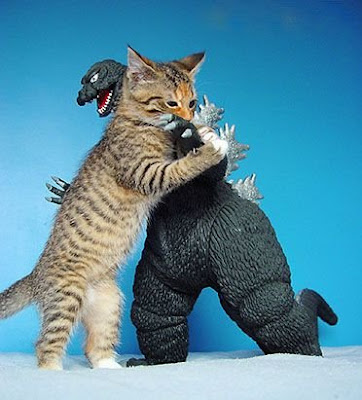
Also, Godzilla.
Meow! Grr!